As southwest Colorado heads into what forecasters expect to be a high-risk fire season, La Plata Electric Association (LPEA) is implementing a coordinated set of operational, technological and community-focused strategies to reduce wildfire risk while continuing to provide safe and reliable electric service to its member-owners.
"As your co-op, we're focused on how we can reduce fire risk every single day in our operations," said LPEA CEO Chris Hansen. "We need each homeowner, business and every member in our co-op to take the risk seriously and work to mitigate their own properties."
Vegetation Management Across 2,000 Miles of Line
LPEA maintains approximately 2,000 miles of overhead line, and keeping trees and branches clear of power lines is among the cooperative's most important and most challenging wildfire prevention tools. Three dedicated crews cycle through the entire system on a two-to-three-year schedule, often climbing trees in terrain that doesn't allow for truck access.
"Keeping branches and trees back is crucial," said Jerry Sutherlin LPEA's Vice President of Distribution Operations. "Whenever tree branches touch power lines, they have the potential of creating sparks, and sparks in a dry climate create fire."
Smarter Technology, Safer Grid
LPEA has partnered with Firescape to deploy machine learning models that assess wildfire risk across the cooperative's service territory on an hourly basis. The platform helps LPEA pinpoint where risk is highest and when, allowing crews and resources to be deployed where they're needed most.
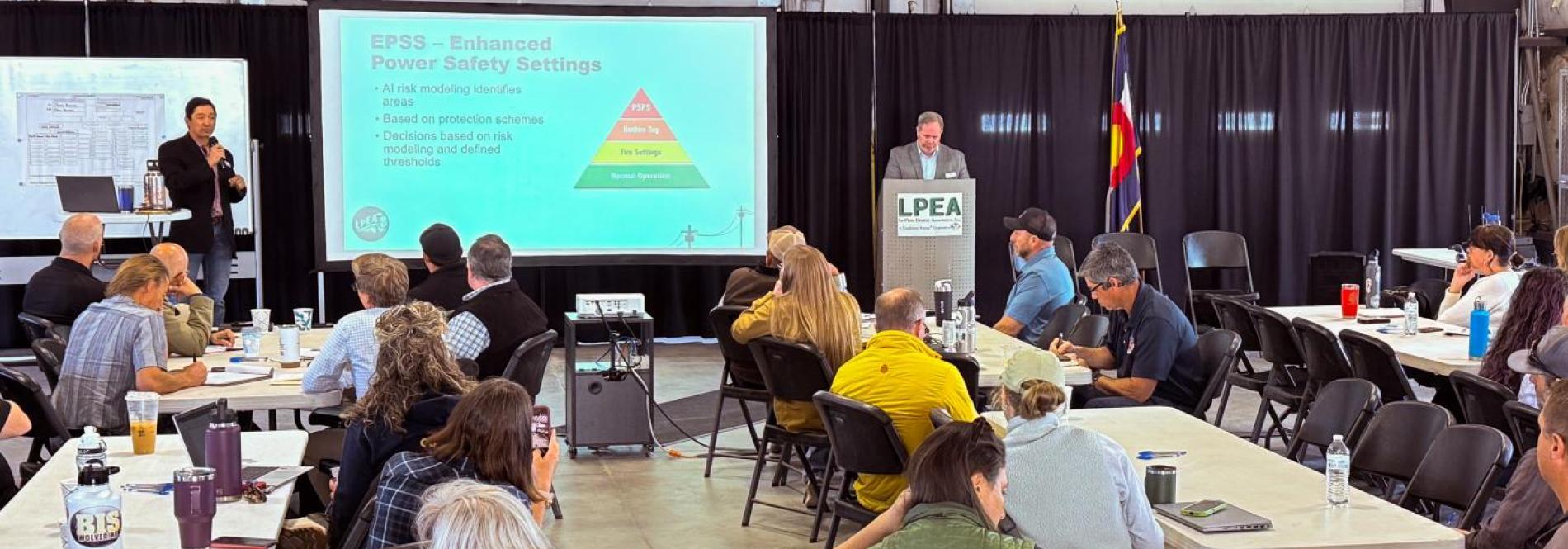
The cooperative is also implementing enhanced grid protection protocols during periods of high fire danger. Known in the industry as "fire settings," these configurations reduce or eliminate the automatic restoration of power after a fault is detected. Members may experience more outages when fire settings are in effect, but this significantly reduces the chance that a power line could ignite a fire.
"We have the ability to set up substations and reclosers with more sensitive settings," said Sutherlin. "A lot of work happens behind the scenes to reduce the risk before members ever see the impact of it."
Public Safety Power Shutoff Preparedness
LPEA has also been developing and refining protocols for Public Safety Power Shutoffs (PSPS), a wildfire mitigation tool that can be used by utility companies to limit the risk of wildfire ignition due to downed equipment or debris. During periods of extreme fire danger, characterized by high winds, low humidity, and dry vegetation, LPEA may need to preemptively shut off power in targeted areas to protect public safety, homes, businesses, and critical infrastructure. The program is designed to improve advance notice when conditions allow and help communities prepare before, during and after an outage.
LPEA is working closely with local emergency management agencies, fire departments, and community organizations to continue to develop and support a coordinated response.
Partnering with the Community
LPEA has also directed its 2026 community sponsorship program toward supporting wildfire mitigation and preparedness. Their first sponsorship recipient has been Wildfire Adapted Partnership (WAP), a nonprofit serving a five-county region in southwest Colorado. WAP helps homeowners reduce wildfire risk on their own properties through site assessments, a network of roughly 140 volunteer neighborhood ambassadors, and a chipper rebate program that reimburses homeowners up to 50 percent of the cost of vegetation clearing.
What Members Can Do Right Now
LPEA is encouraging all members to take two simple steps before fire season gets underway:
- Sign up for alerts: Members can be notified of outages and conditions affecting their area.
- Confirm contact information is up to date: Accurate phone numbers and email addresses allow LPEA to reach members quickly and effectively.